Portfolio Construction for an Uncertain World

Key Takeaways
- Portfolio construction and asset allocation have never been more important given the prevailing economic and geopolitical risks the markets face
- Each constituent element of a well-constructed portfolio should have a clearly defined role
- The assets selected - and their weighted allocation - are key to a portfolio meeting the specific needs of a client
- Forth Capital’s new Global Resilience Strategy demonstrates how good portfolio construction and asset allocation works in practice - to meet the needs of clients with a defined risk appetite and time horizon; combining diversified defensive assets and alternatives, gold as a hard asset diversifier, and measured exposure to growth through global and thematic equities.
In a world increasingly shaped by economic uncertainty, persistent inflation, rising sovereign debt and geopolitical fragmentation, many investors are placing greater emphasis on preserving the wealth they have accumulated - not simply growing it.
For these clients, the question is increasingly:
“How do I protect the wealth I’ve spent my life building?”
To remain invested with confidence through changing market conditions, they need to know that their investment strategy is fit for purpose - aligned with their objectives, attitude to risk and investment time horizon - and supported by a well-constructed portfolio, designed to deliver the resilience they require.
A research-led approach
For more than a decade, Forth Capital has provided its clients with a range of research-led top-decile investment strategies – aligned to their long-term objectives, risk profiles and time horizons.
To strengthen this framework further - and meet the needs of clients placing greater emphasis on preserving purchasing power and protecting accumulated wealth - we have recently introduced the Forth Capital Global Resilience Strategy.
The process followed in constructing this new strategy provides a practical illustration of the discipline at the heart of good portfolio construction: The important role that each different asset must fulfil - and how their selection and weighted allocation are designed meticulously to meet the needs of the client.
Creating a Defensive Core and the Importance of Diversification
The use of the term ‘defensive’ can sometimes be misleading. It is not enough simply to hold assets that carry a low-risk label, as their underlying characteristics, sensitivities and relationship with the rest of the portfolio all need to be considered.
At the core of the Global Resilience Strategy is a range of diverse defensive assets - comprising defensive equities; short-duration bonds; and liquid alternative assets - deliberately broader than the traditional approach of relying exclusively on bonds.
Short-Duration Bonds
Fixed income from government and corporate bonds has traditionally played an important defensive role by helping to moderate equity-market volatility.
However, long-duration bonds can be sensitive to changes in interest rates, so short-duration bonds have been favoured, to provide income and defensive characteristics without exposing the portfolio to the same degree of duration risk.
And whilst corporate bonds can offer greater income than government bonds, during periods of severe market stress they can become more closely correlated with equities, as the markets reassess the financial strength of the underlying companies – creating correlation risk – so this has been taken into account also, with short duration government bonds favoured over corporate bonds.
Defensive Equities
The inclusion of defensive equities in the portfolio provides participation in the growth and profitability of companies whose revenues tend to be more resilient when economic conditions weaken. Businesses in areas such as utilities, healthcare, and consumer staples still carry equity-market risk, but demand for their products and services is generally less sensitive to the economic cycle.
Liquid Alternatives
Liquid alternatives are included to introduce sources of return that are less dependent on conventional equity and bond markets moving in a favourable direction. Their potential value lies in providing differentiated - and potentially less correlated - sources of return.
On occasions when inflation and rising interest rates place pressure on equities and bonds simultaneously therefore, carefully selected alternative assets can help reduce the portfolio’s reliance on the traditional relationship between those two asset classes.
In combination, this diverse mix of defensive equities, short-duration bonds and liquid alternatives creates a robust defensive foundation for the portfolio.
Gold - A Hard-Asset Diversifier
Gold’s value and potential importance within a portfolio comes from its distinctive economic characteristics. It is a scarce physical asset. Unlike fiat currencies, gold cannot be printed or expanded by governments and during periods of inflation, sovereign debt expansion, currency debasement and monetary instability it is therefore serves structurally as:
- a hard-asset diversifier
- a long-term hedge against currency erosion
- a long-term store of purchasing power.
Its role is not to outperform conventional investments in every environment, but to introduce an asset whose behaviour and underlying drivers differ fundamentally from equities, bonds and cash. Within a portfolio designed around resilience, that difference can provide valuable structural diversification.
Exposure to Global Growth
A strategy designed for resilience should not be confused with one designed simply to minimise investment risk. Without sufficient exposure to productive companies and the wider global economy, the portfolio could struggle to outpace inflation, support future withdrawals, and meet the client’s longer-term financial objectives.
The Global Resilience Strategy portfolio therefore includes measured exposure to a globally diverse range of equites, benefitting from the long-term growth and profitability of productive and innovative businesses – but its smaller allocation in relation to the other assets held in the portfolio helps to ensure that the client is not exposed to more volatility and potential downside than their risk appetite dictates.
Thematic Assets - Used with Discipline
The strategy also includes measured exposure to listed global defence companies, reflecting a structural investment theme arising from renewed government commitments to defence expenditure.
It’s important to note however that thematic investing is exercised with discipline, as even where the underlying rationale is compelling, a narrow investment theme can become expensive, volatile or excessively dependent upon political decisions – so the allocation has to remain proportionate - recognising a structural development and providing measured exposure to it, without allowing conviction to become concentration.
Cash – Liquidity and Flexibility
Cash is often regarded as the least interesting component of an investment portfolio, but that overlooks the valuable role it performs.
Within the Global Resilience Strategy, cash provides liquidity and a rebalancing buffer.
When market movements cause different assets to drift away from their intended allocations, available liquidity can help restore the portfolio’s target structure without requiring longer-term investments to be sold at an inconvenient time.
Where regular income is being withdrawn, a period of falling markets can create the risk that growth assets need to be sold after they have declined in value. Maintaining appropriate liquidity can help reduce that pressure and provide greater flexibility over when other investments are realised.
Cash is not included because it is expected to deliver a significant return, but because liquidity has strategic value within a portfolio.
The Importance of Weighted Allocation
Each of these assets within the portfolio performs a different function, and they are not expected to outperform at the same time - nor should they. The purpose of combining the different investments is to ensure that the strategy is supported by more than one source of return and is not dependent upon a single economic or market outcome.
The weighted allocation of the assets within the portfolio needs to reflect their strategic purpose.
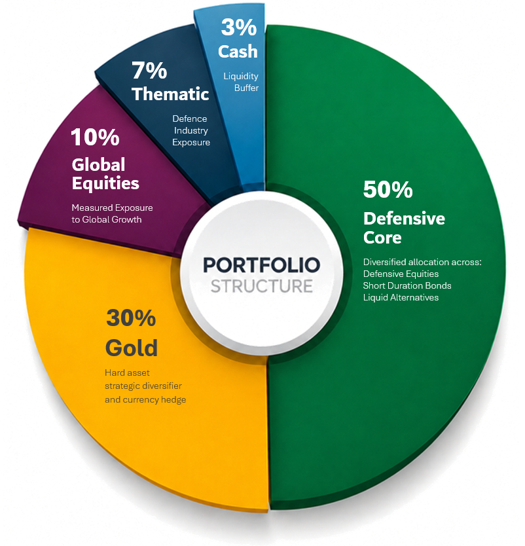
Within the Global Resilience Strategy, the defensive core provides the principal anchor (with a 50% allocation), whilst gold (30%) contributes a meaningful source of hard-asset diversification. Global equities (10% per cent) and thematic equities (7% per cent) are weighted to deliver measured participation in growth – whilst a smaller (3% per cent) allocation to cash provides liquidity and rebalancing capacity.
Built for Resilience in an Uncertain World
The Global Resilience Strategy is a valuable addition to Forth Capital’s proven range of risk-rated investment strategies and illustrates the discipline at the heart of good portfolio construction; combining assets with the requisite characteristics, in the right proportions, to perform a defined role and meet the specific needs of the client.
If you are unsure whether your current portfolio and investment strategy remain aligned with your objectives, Forth Capital can provide you with a complimentary review.
Book Your Complimentary Portfolio Review
We will assess your current portfolio, asset allocation, risk profile, investment time horizon and long-term objectives, to determine whether your strategy remains appropriately structured for the goals you are working towards.
 |
|


Important Information
This article is provided for general information purposes only and does not constitute financial, tax or legal advice. The information reflects our understanding of current UK legislation and HMRC practice at the time of writing, which may change in the future. Tax treatment depends on individual circumstances, including residence and domicile. Individuals should not take action based on this article without seeking personalised professional advice.
This article has been produced and published on behalf of Forth Capital Advisers Limited, Forth Capital (Genève) Sàrl, Forth Capital (Hong Kong) Limited, Forth Capital (USA) LLC, Forth Capital (Australia) Pty Ltd and Forth Capital (Europe) Limited.
Read more of our latest articles





Worldwide

Licences
Please complete the form below with your details and we will get back to you as soon as possible.